

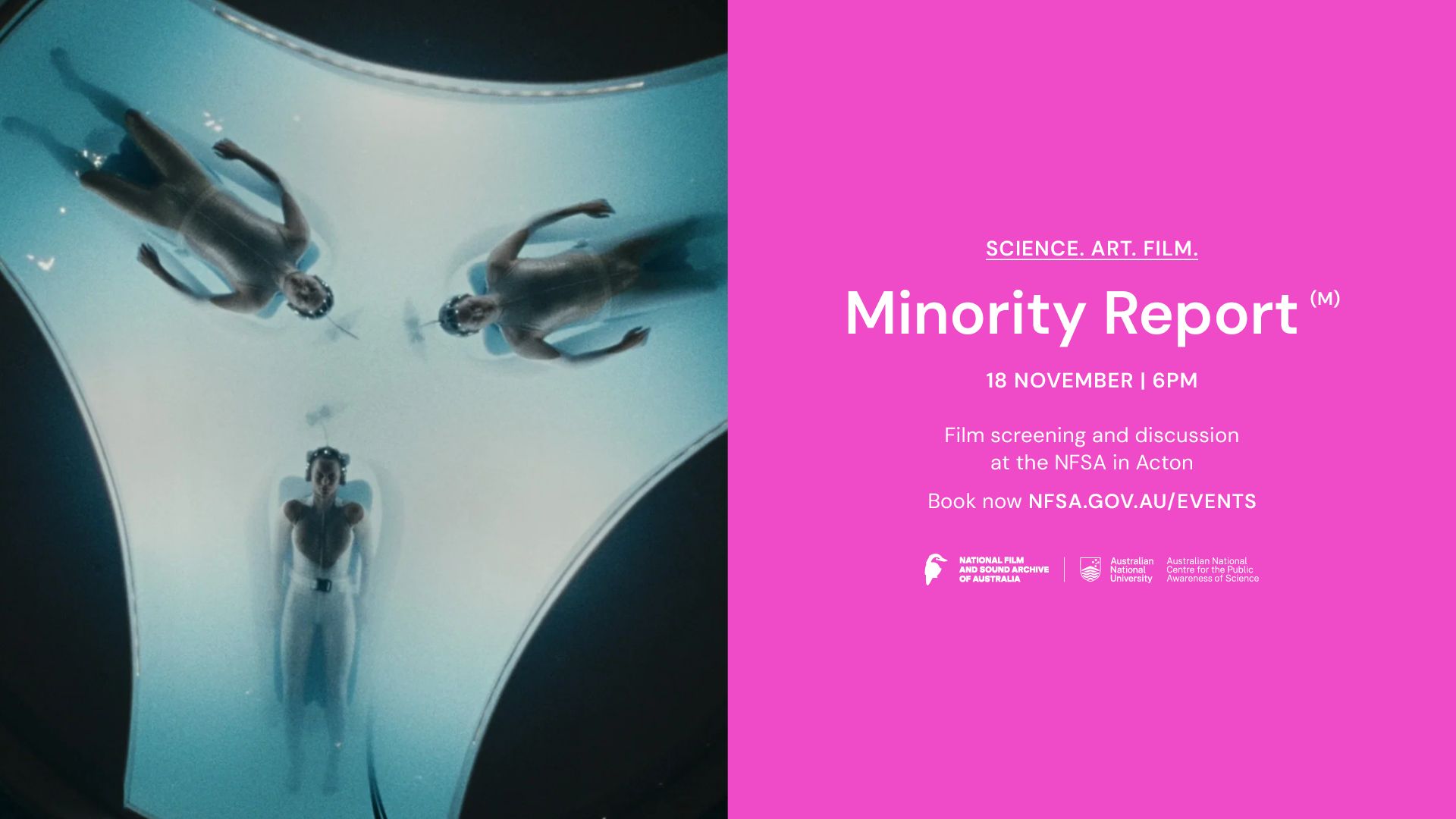
Steven Spielberg’s Minority Report (2002) imagines a world where crimes can be predicted before they happen, raising fascinating questions about free will, surveillance, artificial intelligence and the limits of technological certainty. So, let’s explore these questions together!
Join us on 18 November at 6 pm at Arc Cinema (NFSA) for a lively panel discussion bringing together perspectives from across science, philosophy, technology and culture. Our panellists are Henrique Santos, whose research inspired a book on Minority Report and technological change; Professor Colin Klein (ANU Philosophy), whose work explores consciousness, AI and the philosophy of computation; Professor Kenneth Lampl (ANU School of Music), an award-winning film composer with more than 100 film scores to his name; and Dr Dan Santos (Australian National Centre for the Public Awareness of Science), whose research examines emerging biotechnologies, innovation and public engagement with science.
We’ll explore questions such as: Can technology ever truly predict human behaviour, or does the future remain fundamentally uncertain? What happens when predictions become the basis for decisions about who we are and what we might do? And how does film music help turn technological possibilities into futures that feel thrilling, unsettling or all too plausible? Don’t miss this! 🙂
Get your tickets now: https://www.nfsa.gov.au/whats-on/science-art-film-minority-report-4653
