


By Anneliese Joy – A ‘Science & Humour’ Project (SCOM2006, 2025)
As an astronomy and astrophysics student, whenever I mention my scientific discipline, the reactions I receive highlight the widespread perception of astronomy and astrophysics as an inherently complex and inaccessible discipline. To confront this, I developed an online course, ASTR101: KickSTARting your Astrophysics Voyage, designed to increase public awareness of the field, and present it as accessible for all audiences.
The chosen mode of science communication was an online course, as evidence suggests this format increases students’ motivation and engagement with course content, leading to improved conceptual understanding and information retention (Seng & Mohamad, 2002). Online learning platforms have also demonstrated particular effectiveness in communicating physics concepts to non-physics students, with students who engaged with online platforms demonstrating a deeper conceptual understanding than students who did not use these platforms (Moore, 2018). However, despite these advantages, certain communication styles risk decreased engagement, emphasising a need for effective communication strategies to maintain student involvement in digital learning environments (Akpen, Asaolu, Atobatele, Okagbue & Sampson, 2024). In response, the course videos were designed to communicate content through methods grounded in humour theories, not only to sustain audience engagement, but also because humour has been shown to promote a deeper understanding of course material in online learning (Erdoğdu & Çakıroğlu, 2021). Additionally, quizzes incorporated after each video encourage an active self-reflection on content, enhancing users’ engagement and understanding (Nalaka & Ekanayake, 2021). Designing the course website with a focus on student engagement establishes a strong foundation for this project as an effective science communication tool by offering an innovative format that facilitates active interaction with content. Given the scarcity of online courses dedicated to public science outreach, this project addresses a gap within this mode of science communication.
This scarcity is particularly prominent in astronomy and astrophysics, where astronomers and astrophysicists recognise the importance of communication in challenging discipline stereotypes, but often struggle to connect with audiences due to limited familiarity with science communication theory. This underscores a need for more astronomy and astrophysics content informed by these theories (Anjos, Russo, & Carvahlho, 2021). To meet this need, humour science communication theories were holistically incorporated into the design of the course website, introduction video, four explanation videos, and conclusion video. Subtle humour elements are embedded throughout the written descriptions on the course website, including a pun in the course title and consistent incorporation of space-related wordplay, cultivating a light-hearted atmosphere that humorously subverts the traditionally serious tone of most science courses. This approach directly challenges the perceived inaccessibility of astronomy and astrophysics, and reassures audiences that they can comfortably engage with these concepts.
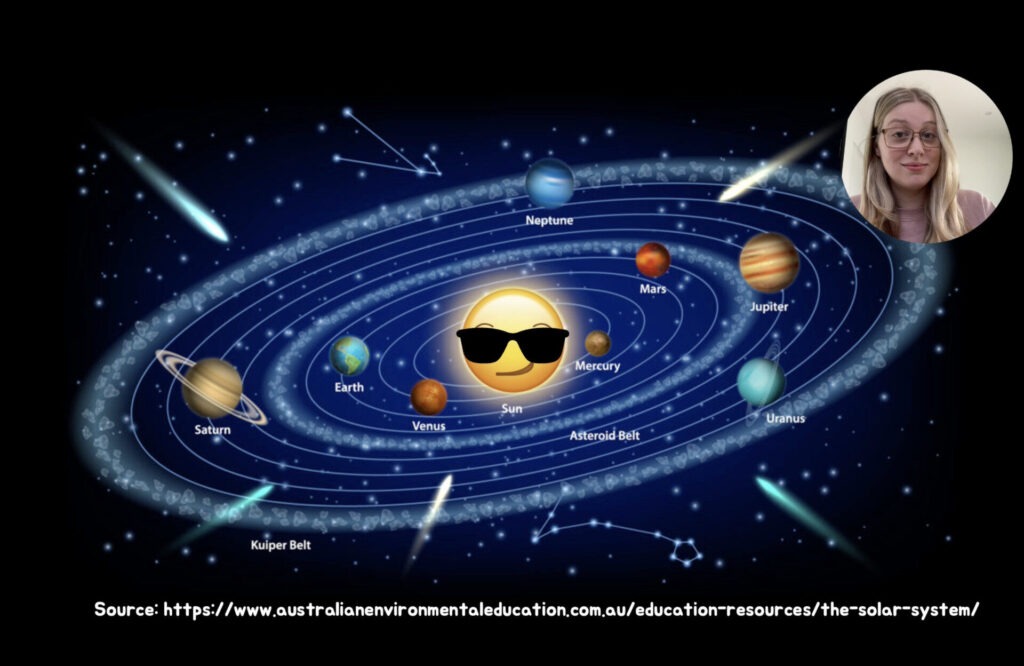
The four main videos strategically employ analogies to reframe seemingly complex astronomy and astrophysics concepts as familiar, everyday situations, making them more accessible to the audience. The analogies enhance the videos’ effectiveness in science communication by contextualising challenging scientific ideas in relatable terms, deepening audience understanding and engagement. However, analogies inherently risk perpetuating further misconceptions or stereotypes, (Taylor & Dewsbury, 2018) a challenge this project addresses by developing original analogies specifically tailored to communicate foundational concepts unique to each video topic. This approach is rarely used in astronomy and astrophysics education, and unlike conventional analogies, reflects a nuanced application of humour theories to support audience engagement and understanding. Humour is a highly effective method in science communication when applied appropriately, however its misuse can distract audiences from the core message. (Meyer, 2000) As a result, humour is carefully incorporated into the analogies to solely facilitate conceptual explanation, avoiding unrelated comedic elements that may detract from the core messages being communicated. Each video employs a unique style of humour, primarily grounded in incongruity theory, to enhance the content delivery. This includes disparagement humour, underpinned by superiority theory, when framing astrology as pseudoscience; absurd humour in likening astrophysics specialisations to everyday jobs; hyperbolic humour to illustrate spectroscopy as the study of anthropomorphised stars’ moods; and parodic humour to explain gravity by imagining planets as contestants on ‘Love Island’. These varied humour types, complemented by the humorous animations informed by incongruity theory, aim to captivate audiences by creating unexpected connections that make astronomy and astrophysics concepts more memorable and accessible.

Overall, the ASTR101 course effectively challenges public perceptions of astronomy and astrophysics as complex and inaccessible. Through innovative integration of humour-based science communication methods informed primarily by incongruity theory, the course promotes a deep engagement and understanding of fundamental astrophysical concepts. This project uniquely addresses the need for astrophysics education grounded in science communication theories to challenge audiences’ stereotypes and promote a broader public engagement with the field.
