
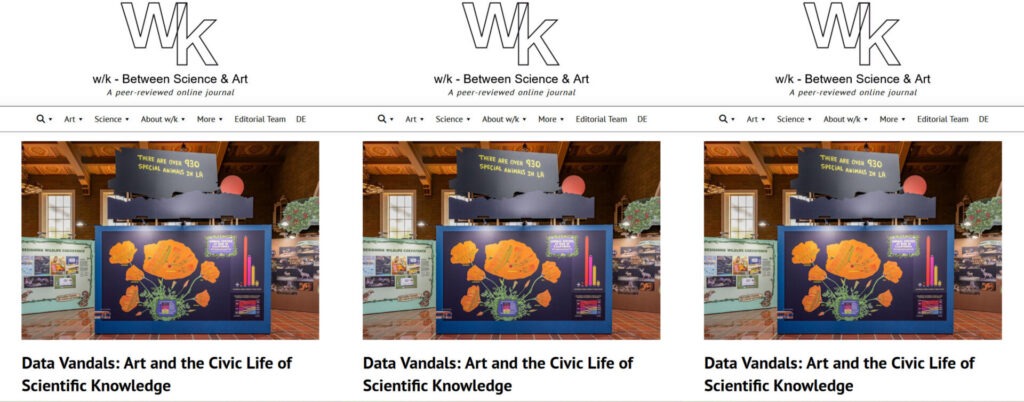
Data Vandals: Art and the Civic Life of Scientific Knowledge
What happens when data leaves reports, dashboards and institutional settings and enters the streets, subway stations and everyday spaces of civic life? In this conversation, artists and designers Jen Ray and Jason Forrest (Data Vandals) discuss a practice and artistic concept that transforms data into public encounters – inviting people to touch, question, interpret and collectively remake information rather than consume it. Drawing on projects such as LA on the Move and the Data Vandals Newsstand, Ray and Forrest reflect on research, visual storytelling, participation and the relationship between data and lived experience. Situated at the intersection of art, data visualisation and civic participation, their practice explores how information can be transformed into a social and visual experience. Through drawings, installations, kiosks, surveys and public encounters, Data Vandals create spaces in which data becomes a catalyst for conversation, storytelling and collective reflection. The interview offers insight into the artistic ideas, methods and ambitions that shape their distinctive approach to working with information in public life.
How to cite this article
Jen Ray, Jason Forrest & Anna-Sophie Jürgens (2026): Data Vandals: Art and the Civic Life of Scientific Knowledge. w/k–Between Science & Art Journal. https://doi.org/10.55597/e10416
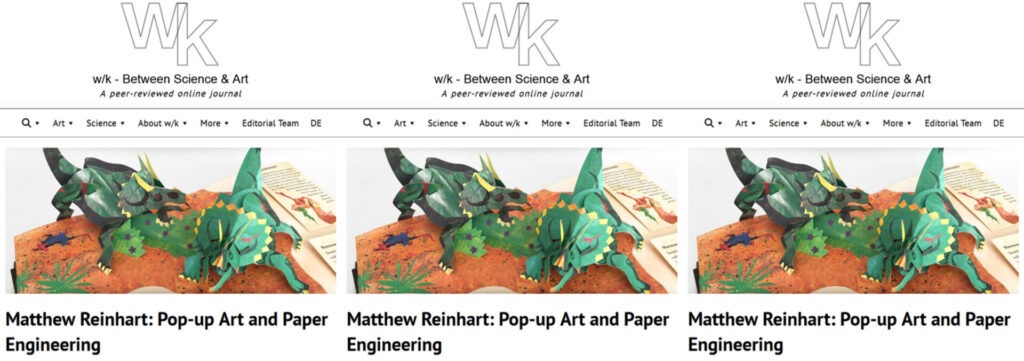
Matthew Reinhart: Pop-up Art and Paper Engineering
This article spotlights acclaimed American author, illustrator and paper engineer and artist Matthew Reinhart, whose extensive body of pop-up book work bridges storytelling, design and scientific imagination. Reinhart has crafted dozens of unique, immersive, three-dimensional reading experiences that range from pop culture icons to science-rich explorations of the natural world. In this article, Reinhart discusses how his tactile and dynamic books ignite curiosity, invite questions and transport readers – both young and old – into captivating science realms. The conversation delves into the encyclopaedic pop-up format, exploring its potential as a compelling tool for science communication and creative exploration. It elucidates Reinhart’s artistic concept but also how Reinhart pop-up books merge meticulous craftsmanship with immersive storytelling to make science accessible and, ultimately, exciting.
How to cite this article
Matthew Reinhart & Anna-Sophie Jürgens (2025): Matthew Reinhart: Pop-up Art and Paper Engineering. w/k–Between Science & Art Journal. https://doi.org/10.55597/e10377
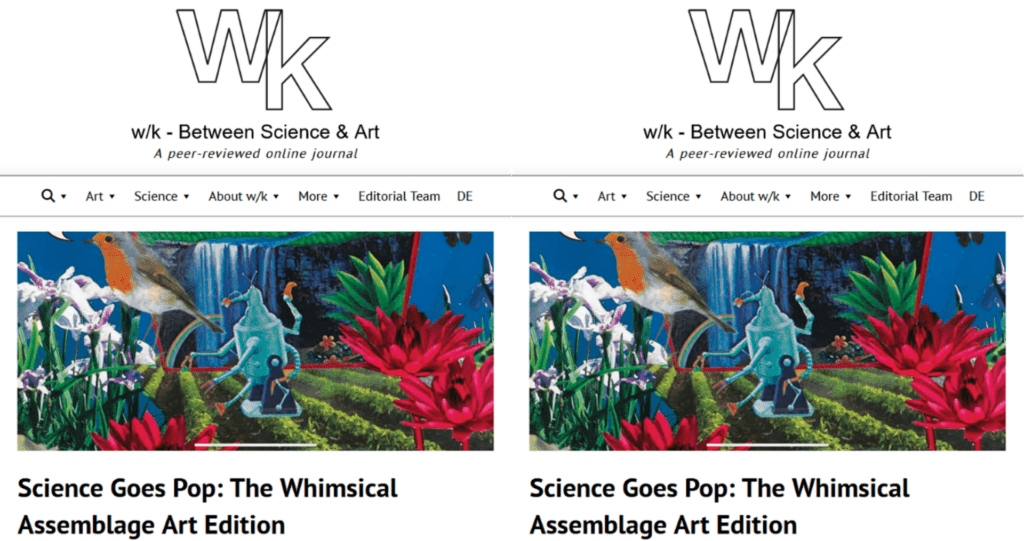
Science Goes Pop: The Whimsical Assemblage Art Edition
This article brings into dialogue two artistic responses to academic discourses on science and its surrounding cultural narratives. Houl and Britt Nichol’s artworks explore science through the lens of comics, artistic imagination and visual storytelling by framing and reflecting on scientific work (in progress) as both deeply personal and situated in cultural contexts. In Isolated and Restricted,Houl visually meditates on isolation in science, challenging the framing of legitimacy across formal and informal labs, drawing from Dan Santos’ conceptualisation of restricted scientific spaces – laboratories, garages and fantastical bat-caves. Nichol’s Vision of a Hopepunk Future draws on solar- and hope-punk to counter anxieties around biotech with optimism and care. Both pieces use visual metaphors and multimodal techniques to interrogate societal narratives about science, and propose visual languages that reimagine science as emotionally rich and radically hopeful. In their works, art becomes both a site of critique and a blueprint for scientific re-enchantment.
How to cite this article
Houl, Britt Nichols, Dan Santos, Crystal Leigh-Clitheroe and Anna-Sophie Jürgens (2025): Science Goes Pop: The Whimsical Assemblage Art Edition. w/k–Between Science & Art Journal. https://doi.org/10.55597/e10326
Science Goes Pop: The Zine Art Edition
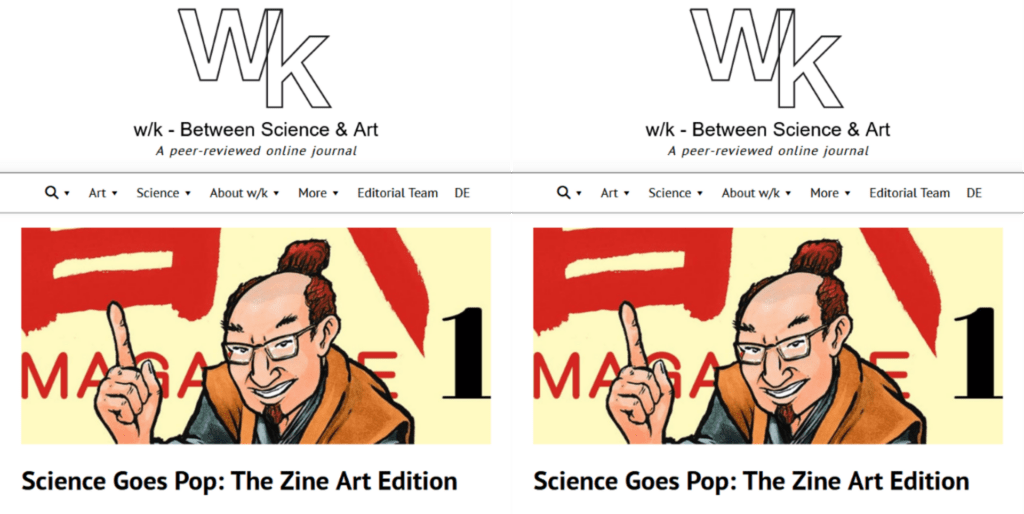
Drawing inspiration from scholarly discussions on manga as a historically inflected form of educational media, as well as comic books featuring eccentric scientists, visual artists Patrick Galvin and Camilo Potocnjak Oxman explore the dynamic interplay between art and science in this article. Their artworks demonstrate how science can function as both content and an imaginative and aesthetic force deeply embedded in cultural narratives. Combining pop culture motifs with photographic realism, they reveal how scientific ideas permeate visual storytelling. They also investigate manga covers that draw on traditional Japanese aesthetics as examples of narrative accessibility, leveraging familiar stylistic codes to engage audiences in the communication of research and knowledge. Together, their artistic concepts and artworks present science and art as equal partners in the creation of meaning and the enjoyment of knowledge across diverse media.
How to cite this article
Patrick Galvin, Camilo Potocnjak Oxman, Stefan Buchenberger, Torsten Weber and Crystal Leigh-Clitheroe (2025): Science Goes Pop: The Zine Art Edition. w/k–Between Science & Art Journal. https://doi.org/10.55597/e10327
Science Goes Pop: Superhero Art Edition
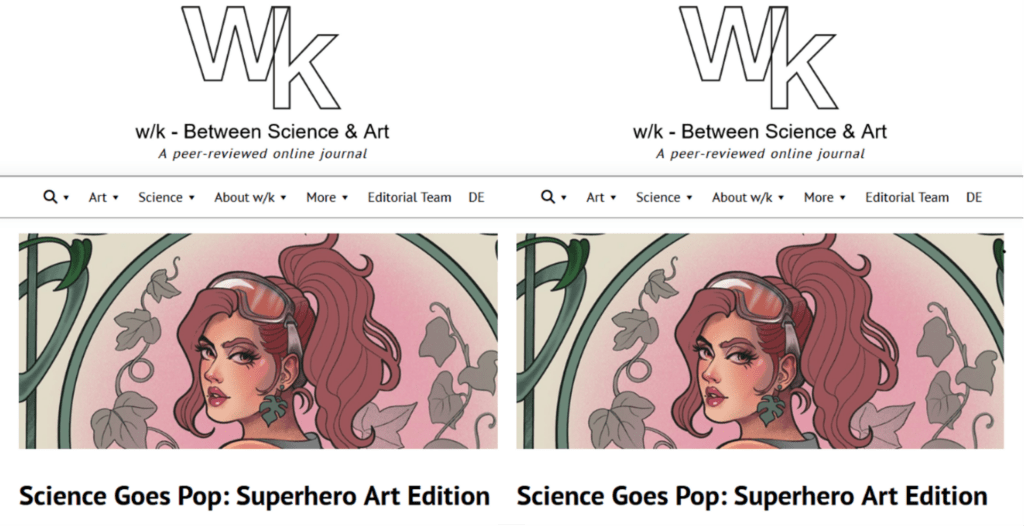
In this article, visual artists Kel Ronning and Kikifoxbones reflect on the aesthetic strategies used to communicate science through the visual language of superhero comics – from the glitchy remix aesthetics of Miles Morales (Spider-Man) to the intentionally exaggerated and visually implausible ‘scientific’ moments often found in DC Comics. By foregrounding the artistic process alongside academic rationale, the articles invites readers to discover how visual art can subvert conventional science tropes and translate scholarly content into compelling, culturally embedded forms. More than just illustration, their work fosters art-driven dialogue about what science means to different people, encouraging connection, critique and cultural storytelling. It invites the audience into a conversation where science is not just explained, but reimagined and made accessible through shared visual vocabularies and creative collaboration.
How to cite this article
Kel Ronning, Kikifoxbones, Ben Nickl, Anna-Sophie Jürgens and Crystal Leigh-Clitheroe (2025): Science Goes Pop: Superhero Art Edition. w/k–Between Science & Art Journal. https://doi.org/10.55597/e10328
SuperScientists: Celebrating science through the power of superheroes
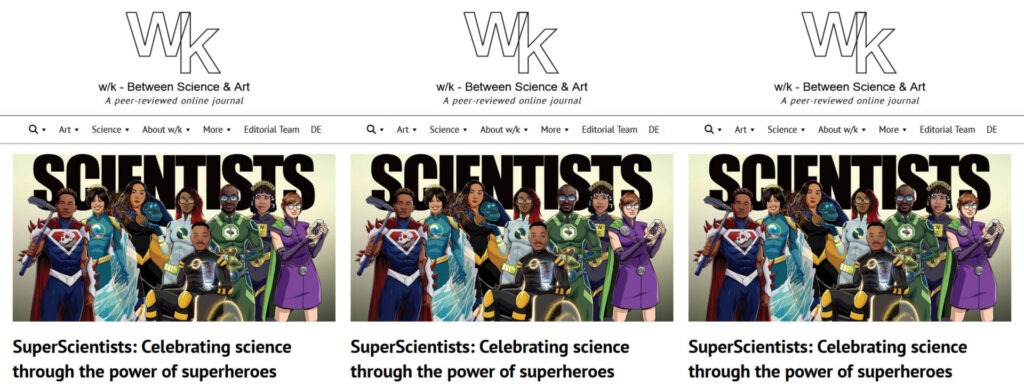
In this conversation, Dr Justin Yarrow and Clyde Beech discuss the SuperScientists project, which combines science communication and comic art to inspire and educate South Africans, especially schoolchildren. The project captures the public imagination by reimagining scientists as larger-than-life superhero characters through trading cards, comics, and animations. The creative vision uses superhero aesthetics to celebrate scientific achievements while making science approachable. SuperScientists bridge the gap between science and comics’ superhero culture, helping children see scientists as relatable heroes and inspiring scientific pursuits. The project shows how art and visual narrative can transform abstract scientific concepts into engaging stories for all ages.
How to cite this article
Justin Yarrow, Clyde Beech, Crystal-Leigh Clitheroe and Anna-Sophie Jürgens (2025): SuperScientists: Celebrating science through the power of superheroes. w/k–Between Science & Art Journal. https://doi.org/10.55597/e10289
Introducing a new series in the peer-reviewed online journal w/k – Between Science and Art
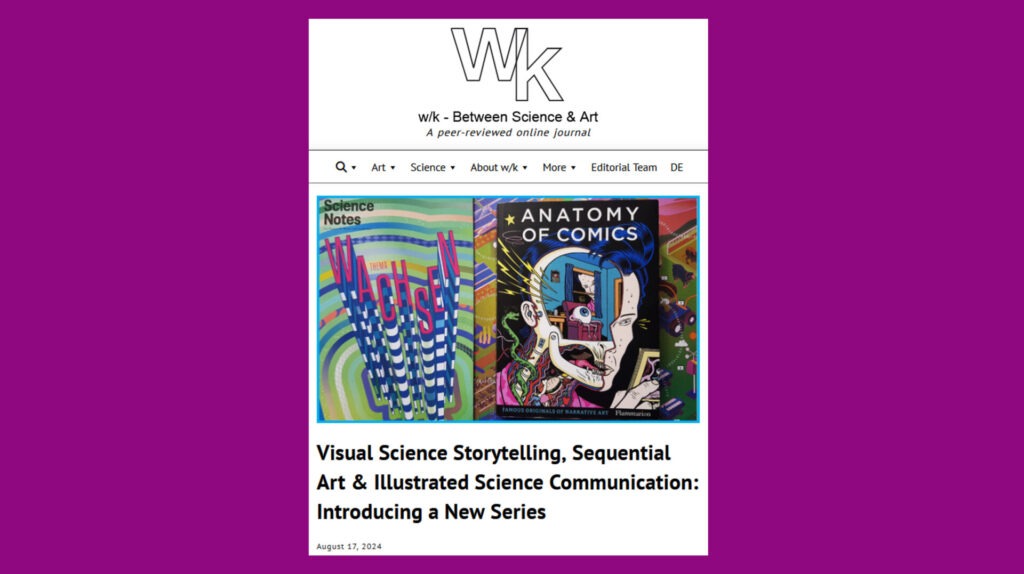
This series is dedicated to the study of art forms that use images in a particular order and/or illustration to tell visual stories about science (or) for the purpose of communicating science. In this series we unpack the artistic concepts of professional visual artists and (their) projects, and how they explore and communicate science and scientific research through various forms of sequential art – through science-based comic art, graphic science, (fictional) science comics, AR comics and related forms – as well as through visual media revolving around the science-art interface (e.g. science magazines) that include science illustrations and engage in illustrated science communication. By by better understanding the many fascinating artistic concepts as they unravel in and across this series, we clarify the range and power of scientific storytelling techniques developed and applied by visual artists – also referred to as pictorial storytelling, picto-narrative, narrative illustration – and the ways in which they communicate scientific research and convey meanings of science.
How to cite this article
Anna-Sophie Jürgens & Crystal-Leigh Clitheroe (2024): “Visual Science Storytelling, Sequential Art & Illustrated Science Communication: Introducing a New Series.” w/k–Between Science & Art. https://doi.org/10.55597/e9741

Matteo Farinella: Illustrated Science Communication & Visual Science Storytelling
Professional visual artists and cartoonists can produce detailed graphic narratives that deliver scientific insights, messages and meanings in a relatable way to a wide range of audiences. Nowhere is this more evident than the increasing use of comics material in science communication in every field. In our first interview of this series, we ‘pick the brain’ of visual artist, passionate neuroscientist and science communicator, Dr Matteo Farinella. Matteo’s career as a science artisan and cartoonist began when he connected the visual study notes and diagrams he created to help him understand his studies with his passion for drawing, and points out how comics he read as a child likely influenced his approach to both. He emphasises that science communication is the core of the creation of his educational comics and information-rich visuals, but he also completely embraces the undefined, informal nature of the comics medium to do this effectively. Exquisitely-detailed illustrations and warm visual narratives throughout this interview are testament to his extraordinary technical skill.
How to cite this article
Anna-Sophie Jürgens & Crystal-Leigh Clitheroe (2024): “Matteo Farinella: Illustrated Science Communication & Visual Science Storytelling.” w/k–Between Science & Art. https://doi.org/10.55597/e9752
