

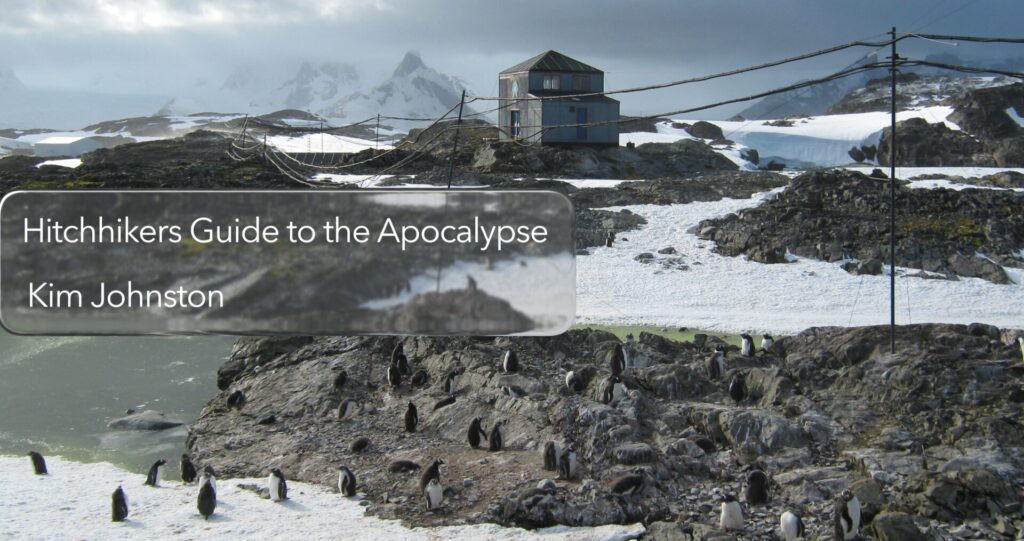
By Kim Johnston – A ‘Science & Humour’ Project (SCOM6006, 2025)
Fiction can create hypothetical worlds which explain complex scientific theories (Negrete, 2002). Literary fiction that includes climate change encourages the reader to imagine its impacts (Rong, 2023). My creative piece SCOM6006 submitted was designed to encourage the audience’s imagination. This can trigger an emotional response leading to action (Rong, 2023). This is why a book chapter was chosen for the creative project.
Several authors have written travel journals to communicate science. Douglas Adams wrote Last Chance to See as a comedy to raise awareness about endangered species (Adams & Carwardine, 2011). Before writing On the Origin of Species, Charles Darwin wrote The Voyage of the Beagle – a travel adventure that includes history, biology and geology (Darwin, 1859; Darwin, 1909). More so, The Martian is a fictional log of a NASA astronaut. The book is based on the best available scientific information at the time. It uses the story to explain complex scientific principles from the Martian environment to long distance space travel (Weir, 2014). The success of these books has demonstrated the ability of literature to communicate science and raise awareness of important political issues (Tacer, 2023).


Melting ice has been used as a metaphor for environmental destruction by a diverse range of artists (Hemkendreis & Jürgens, 2024). In pop culture, the animated Ice Age movies use humour to engage the audience while taking the negative impacts of climate change seriously (Holliday et al., 2023). Getting the balance between entertainment and conveying an accurate message is critical when communicating climate science (Kaltenbacher & Drews, 2020). Research of science communication that uses humour to promote action on climate change showed that it had a positive effect for awareness of the issue but a mixed effect for perception, learning and behavioural change (Kaltenbacher & Drews, 2020). In these contexts, humour has been connected to stimulate interest in knowledge and research, to increased attention and lowering stress levels (Savage et al., 2017). A study at Loma Linda University, California, for example, uses a humorous intervention to compare the learning ability of adults in a controlled experiment. There was a significant increase in leaning ability in the group with the humorous intervention compared to the control group (Bains et al., 2014). Another study compared the ability to learn science using a list of fact or a narrative story. Both groups were tested twice to compare short term and medium term memory (Negrete, 2002). The group that was given the list of facts performed slightly better on the short term memory test but no better and sometimes worse on the medium term memory test. The results show that literary stories are an effective form of science communication (Negrete, 2002).
For image credits and contexts, see report
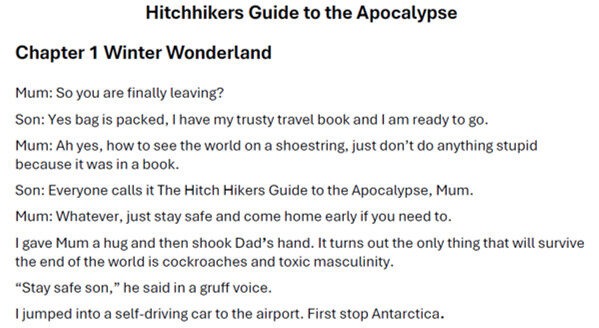
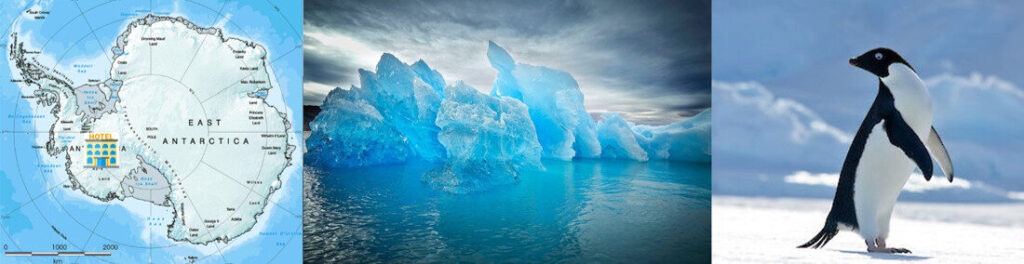
The creative piece submitted for SCOM6006 combines a narrative with images. The story uses a future fictional world where global warming has melted all the ice and snow on Earth, except for Antarctica. The images show the beauty of the frozen world while the writing incorporates science into the plot. A combination of current scientific knowledge and potential future scientific developments is communicated, including:
- the Antarctic climate and environment;
- the impact of artificial intelligence on the workplace; and
- how genetic engineering can bring back endangered species.
My story uses a combination of irony, farcical situations and schadenfreude to engage the reader. This style of humour is supported by the incongruity theory (Meyer, 2000). Incongruous fiction does not have to be humours it can also be tragic (Dadlez & Lüthi, 2018). A mixture of tragedy and comedy is used with a series of warning signs. The first two signs show increasing danger, the last one breaks the pattern. This surprise is unexpected and breaks the natural order, creating humour (Meyer, 2000). On page 14, a conversation between the main character and a child is used to explain the climate of Antarctica. Tension is created by the children arguing with the adult. This is relieved through the children’s innocent interpretation of the science.
“Does that mean Antarctica is a superhero?”
Creating tension followed by release is an effective comic devise (Gadsby, 2022). The situational humour also has elements of schadenfreude, where readers are invited to laugh at the misfortune of the main character. This is turned around as the main character uses the children’s analogy as a metaphor for explaining the importance of the polar vortex. Climate science is also communicated on page 5 through a description of blue ice. Images are also used to show the natural beauty of the landscape reinforcing the message that the land, ocean and air are connected. Humour is used on page 7 with a description of mountains that are so tall that snow does not want to fall on them. These descriptions of the Antarctic environment are based on scientific research (Walton, 2013). There is also speculation about what might be possible in the future. On page 11, now extinct animals are brought back to life. This is done for comic purposes in line with the incongruity theory (Meyer, 2000). A huge leap in technology would be required to bring back a thylacine, let alone a velociraptor raptor (Ashley & Don, 2002). However, referring to species recently pushed to extinction by humans reminds the reader that while we may one day have the power to bring some animals back, we were also responsible for their demise (Bienvenue & Chare, 2022).
Travel journals have been used in science communication for over one hundred years. The fusion of this style with incongruous humour and images increases the effectiveness of the science communicated. A book chapter was chosen for the creative project as the written word can engage the imagination of audiences, empowering them to act.
Abrahamsen, E. (2012). Oceanographic conditions beneath Fimbul Ice Shelf, Antarctica
Adams, D., & Carwardine, M. (2011). Last Chance to See. Random House Publishing Group. https://books.google.com.au/books?id=xmHwAVbVGm0C
Ashley, D., & Don, C. (2002). Collection of two articles on a project to use DNA from the thylacine to bring it back from extinction. Australasian science, 23(6), 14-15.
Bains, G. S., Berk, L. S., Daher, N., Lohman, E., Schwab, E., Petrofsky, J., & Deshpande, P. (2014). The effect of humor on short-term memory in older adults: A new component for whole-person wellness. Advances in mind-body medicine, 28(2), 16-24.
Berman, S. (2022). The World’s Scariest Chairlifts, And Why We Can’t Get Enough of Them. Retrieved 12/08/2025 from https://www.skimag.com/ski-resort-life/worlds-scariest-ski-lifts/
Bienvenue, V., & Chare, N. (2022). Animals, Plants and Afterimages : The Art and Science of Representing Extinction. Berghahn Books. https://doi.org/10.1515/9781800734265
Burdick, A. (2017). On This Summer Solstice, Be Glad You Live on Earth. The New Yorker.
Carvajal, G. (2025). Blue Ice, the Dazzling Natural Spectacle Hidden in Glaciers. Visit Greenland. Retrieved 06/08/2025 from https://www.labrujulaverde.com/en/2025/06/blue-ice-the-dazzling-natural-spectacle-hidden-in-glaciers/
Dadlez, E., & Lüthi, D. (2018). Comedy and Tragedy as Two Sides of the Same Coin: Reversal and Incongruity as Sources of Insight. The Journal of aesthetic education, 52(2), 81-94. https://doi.org/10.5406/jaesteduc.52.2.0081
Darwin, C. (1859). On the origin of species by means of natural selection.
Darwin, C. (1909). The Voyage of the Beagle: With Introduction, Notes and Illustrations. P.F. Collier. https://books.google.com.au/books?id=qDN4mQEACAAJ
Gadsby, H. (2022). Ten Steps to Nanette: A memoir situation. Allen & Unwin. https://books.google.com.au/books?id=gGQ7DwAAQBAJ
Hemkendreis, A., & Jürgens, A. S. (2024). Communicating Ice through Popular Art and Aesthetics. Springer International Publishing. https://books.google.com.au/books?id=G2H8EAAAQBAJ
Holliday, C., Jürgens, A.-S., Thaker, P., Judd, K., Fiadotava, A., & Hemkendreis, A. (2023). Humour for Change? Melting Ice and Environmental Fragility in the Animated Film Comedies Ice Age: Meltdown and Happy Feet 2. Journal of Science and Popular Culture, 4(2).
Kaltenbacher, M., & Drews, S. (2020). An Inconvenient Joke? A Review of Humor in Climate Change Communication. Environmental communication, 14(6), 717-729. https://doi.org/10.1080/17524032.2020.1756888
Kloza, K. (2020). Adélie penguin. Canberra: Australian Government Retrieved from https://www.antarctica.gov.au/galleries/photo-galleries/animals/penguins/
Meyer, J. C. (2000). Humor as a Double-Edged Sword: Four Functions of Humor in Communication. Communication theory, 10(3), 310-331. https://doi.org/10.1111/j.1468-2885.2000.tb00194.x
Negrete, A. (2002). Science via fictional narratives. Communicating science through literary forms. Ludus vitalis, 10(18), 197-204.
Rong, M. (2023). Climate fiction: A promising way of communicating climate change with the general public. Studies in Social Science & Humanities, 2(2), 21-27.
Savage, B. M., Lujan, H. L., Thipparthi, R. R., & DiCarlo, S. E. (2017). Humor, laughter, learning, and health! A brief review. Advances in physiology education.
Selden, S. (2016). Three Angry Polar Bears. Churchill Photography. Retrieved 13/08/2025 from https://churchillpolarbears.org/2016/01/three-angry-polar-bears/
Tacer, Ö. (2023). Martian Structures in Modern Science Fiction and the Home of the Martian (The Martian). In Architecture in Contemporary Literature (pp. 221-229). Bentham Science Publishers.
Walton, D. W. H. (2013). Antarctica : global science from a frozen continent (1st ed.). Cambridge University Press. Weir, A. (2014). The Martian. Ebury Publishing. https://books.google.com.au/books?id=_LnEAgAAQBAJ
